Anna Stirling’s presentation at PME49
27. July 2026. - 01. August 2026.
Helsinki, Finnország
2026. July 27. - 2026. August 01.
Helsinki, Finnország
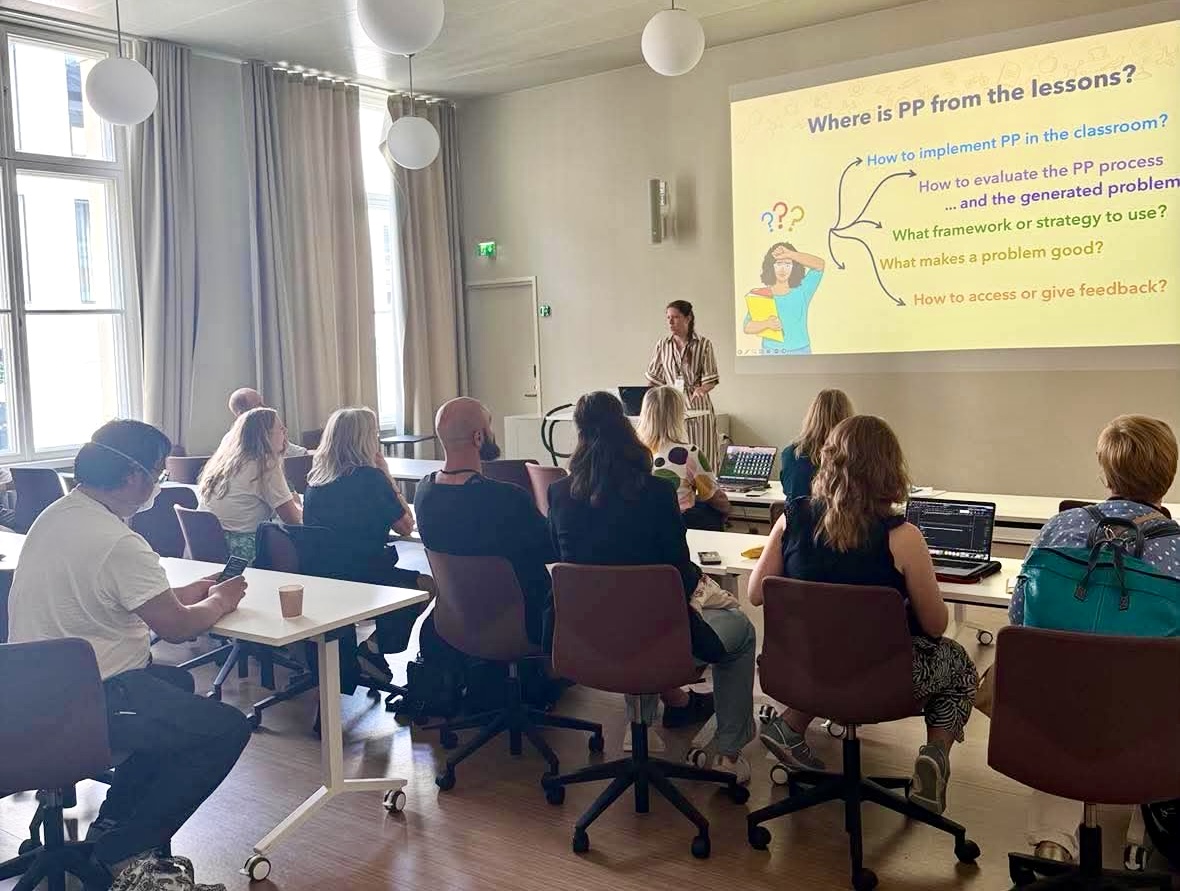
Anna Stirling gave a presentation (OC) at the Psychology of Mathematics Education (PME 49) conference in Helsinki, titled Refining a Tool for Evaluating Students’ Mathematical Problem Posing.
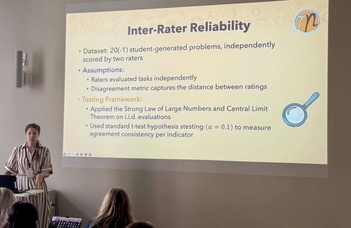
Problem posing (PP) is increasingly recognized as a core component of mathematical proficiency, fostering creativity and higher-order cognitive functions. In this generative process, students construct personal interpretations of concrete situations to formulate meaningful problems (Stoyanova & Ellerton, 1996). Despite its benefits, PP remains marginalized in curricula as teachers often hesitate to integrate it due to a lack of familiarity, time, or practical frameworks (Cai & Hwang, 2023). To provide teacher support and facilitate classroom implementation, we examined Leavy and Hourigan’s (2022) eight-dimensional Framework for Posing Elementary Mathematics Problems (F-PosE). Our study employed mixed methods to evaluate the applicability of F-PosE in a secondary education context with 16 high-achieving 10th-grade students. Over two weeks, groups developed problem sets covering algebra and geometry. The resulting 20 tasks were independently scored by two raters using F-PosE indicators. To ensure objectivity, a specialized form of inter-rater reliability (IRR) was applied to compare the scores and identify discrepancies in the framework’s interpretation. The IRR analysis revealed mixed results regarding objectivity. While the raters were statistically consistent in scoring certain dimensions, other factors proved highly subjective, leading to differing interpretations. Based on these findings, we conducted a thorough investigation into the causes of these discrepancies. Consequently, we propose a refined F-PosE framework that retains the consistent indicators while broadening the definitions of others to include both contextual and intrinsic mathematical motivation. The goal is to provide a more teacher-independent feedback tool that bridges the gap between PP theory and formative assessment in the classroom.